
Lessons Learned That Changed the Game — 8 Kaizens in 60 Days
How UzzAI collected, prioritized and implemented continuous improvements to elevate governance, decision speed and culture in just two months.
Kaizen as Daily Fuel
Eight improvements documented in 60 days generated real impact on decisions, culture and predictability within UzzAI.
In 60 days of formal operation we recorded 23 meetings, 114 decisions and, most importantly, eight kaizens that changed the game. Every retrospective became a reapplicable learning. This account shows how we monitored, prioritized and executed continuous improvements without losing momentum.
Why do we monitor kaizens?
- Ensure every relevant decision is documented and easy to consult.
- Prevent errors and rework from repeating — every retrospective becomes insight for the next sprint.
- Give visibility to the team with tracking dashboards and dedicated views for blockers.
Visual summary
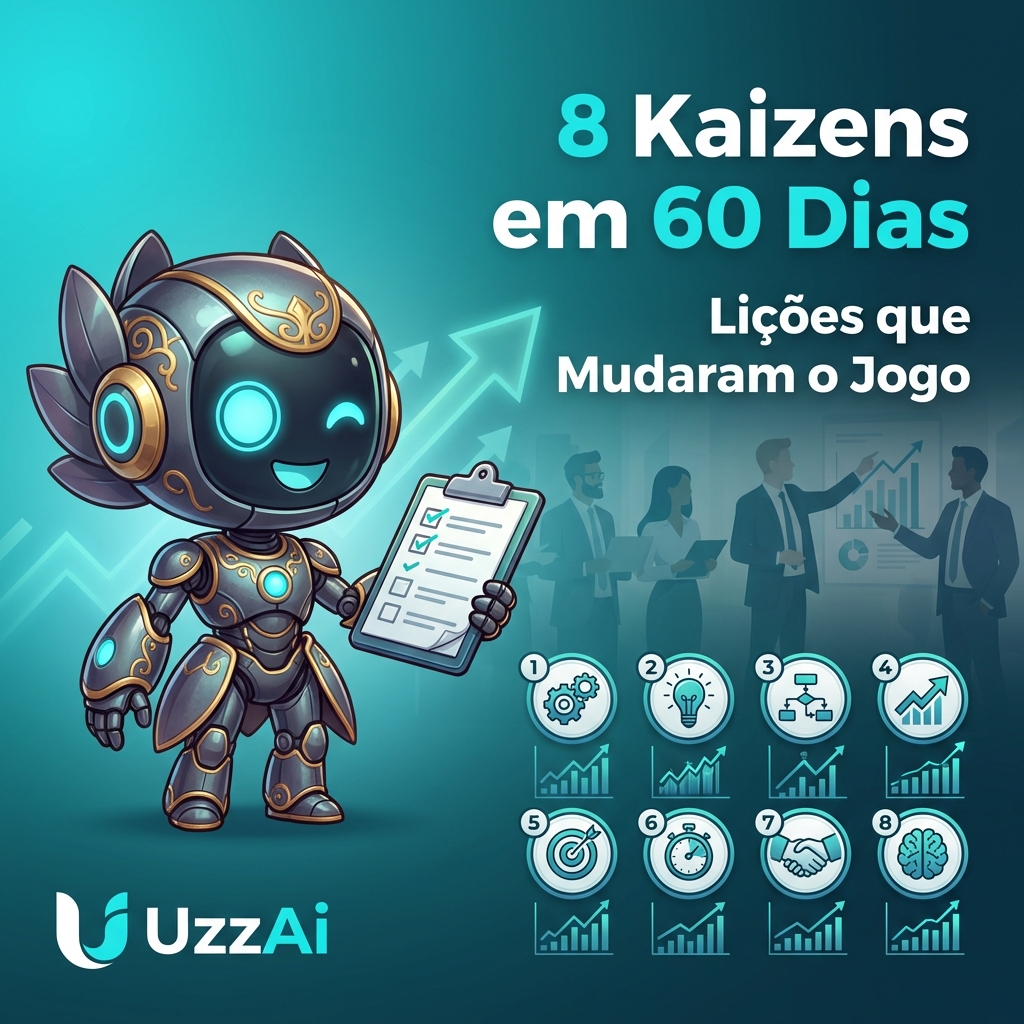
The 8 kaizens that made a difference
- 1Active async communication — decisions in official channels, always recorded in the vault.
- 2Points System V2.0 — compensation based on deliverables, not hours.
- 3Bring conclusions, not research — meetings focused on decision; research comes pre-worked.
- 4Structured weekly meetings — fixed agenda, metrics and action items reviewed live.
- 5Content before design — complete textual production before approving layout.
- 6AI-Assisted Methodology — five-phase framework to accelerate planning and execution.
- 7Philosophy of "Excellence in Everything" — prioritize quality even in MVPs to reinforce branding.
- 8Constant blocker review — central dashboard with critical blockers, owners and deadlines.
We do not treat kaizen as a "wish list". Each improvement goes through a rigorous ritual of documentation and execution to ensure it becomes action — not just insight.
Documentation ritual
- Every meeting generates minutes with decisions, owners and identified lessons learned.
- Each kaizen receives an ID, estimated impact and status (implemented / pending).
- Dashboards display active kaizens to keep the team aware of next steps.
Execution cycle (from trigger to learning)
- 1Identification — arises in a meeting, client feedback or indicator.
- 2Recording — noted in the "Lessons Learned" block of the corresponding minutes.
- 3Planning — we define owner, deadline and concrete action.
- 4Implementation — action item goes to the Action Items Dashboard.
- 5Review — we check impact and decide whether to maintain, adjust or escalate.
Tangible impact in numbers
- Async communication → time to formalize decisions dropped by 30%.
- Points System V2.0 → engagement from partners and contractors increased noticeably.
- Conclusions in meetings → we went from 8 to 12 actions per meeting.
- Weekly rituals → critical blockers dropped from 5 to 2.
- Content before design → Site Builder accelerated, without layout redirections.
- AI-Assisted Methodology → projects designed in 1 day (previously: weeks).
- Excellence in Everything → demos generated positive feedback on quality.
- Blocker review → we resolved risks 2x faster.
Practical cases that validated the kaizens
Content before design
Twelve texts approved in a single meeting; site in production in 10 days, without layout rework.
Documented decisions
Active async communication + complete minutes. Architectures were approved without friction, team confident to execute.
AI blocker resolved
Blockers dashboard highlighted a bottleneck with AI tools. A dedicated sprint freed the project with the selection of Gemini Pro.
How to replicate in your company
- 1Choose a central tool (Obsidian, Notion, Confluence) and keep everything there.
- 2Create meeting templates with sections for decisions, actions and kaizens.
- 3Establish a weekly ritual to review kaizens, blockers and metrics.
- 4Implement dashboards to provide instant visibility of ongoing improvements.
- 5Assign ownership: each kaizen needs an owner, deadline and checklist.
- 6Celebrate and reassess: when a kaizen generates impact, document and communicate to the entire team.
Frequently asked questions (Kaizen FAQ)
Next evolutions of our system
- Create a visual wall of implemented kaizens with an interactive timeline.
- Generate monthly impact reports for leadership and partners.
- Turn recurring kaizens into official playbooks and training programs.
- Integrate culture indicators and NPS into the central dashboard.
Related resources
- Central indicators and active kaizens dashboard.
- Action items panel with priority tasks and owners.
- Site Builder Case — the impact of the "content before design" rule.
- Chatbot Case — documented decisions that became concrete improvements.
- AI-Assisted Methodology — framework that feeds our continuous improvement cycle.
Want to implement a kaizen cycle in your operation?
The UzzAI team helps structure rituals, templates, dashboards and indicators so that continuous improvement becomes part of your routine.
Talk to UzzAI